
Inside Block’s $21 Billion Machine: How It Prints Profits from Every Transaction
Discover how Block’s two-sided financial ecosystem—Square for businesses and Cash App for consumers—creates unstoppable network effects that drive 65%+ margins.
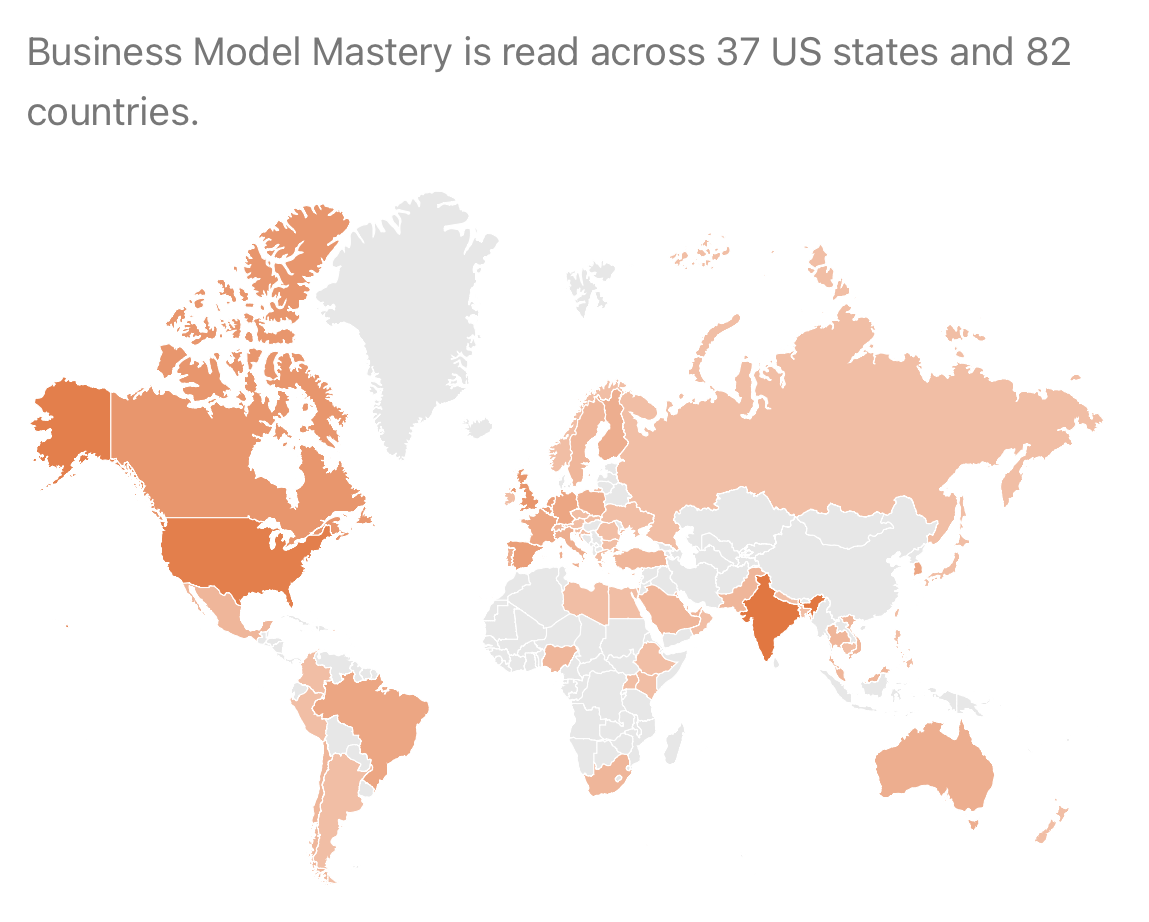
Trusted by 1,850+ private investors worldwide, Business Model Mastery is your daily ritual for building an edge over the market.
Each issue breaks down how great businesses truly operate—and what sets them apart by analyzing one company a day, helping you steadily build your own mental database of business models.
I handle the heavy lifting—digging into reports, filings, and key data—so you can focus on recognizing superior business models, comparing opportunities, and outthinking the market.
With 85+ business models analyzed so far, you have a growing library of insights at your fingertips. Each analysis brings you closer to sharpening your edge and building the conviction to invest with clarity and confidence.
If you haven’t yet, lock in the lowest price before rates rise.
Let’s begin.
I remember the first moment I realized Block had a gravitational pull of its own. It wasn’t just another fintech firm riding the wave of digital payments. Something deeper was happening, something that could keep a seasoned investor like Stephen Mandel allocating over 2% of Lone Pine Capital’s portfolio to it. When I looked under the hood, I saw two interconnected engines—Square and Cash App—fueling each other’s growth in a way that felt almost like a perpetual motion machine. The more I examined the layers of synergy between these two sides, the more obvious it became: Block isn’t just selling payment services. It’s building an entire ecosystem where consumers and businesses become tightly woven into its fabric.

At first glance, it may look straightforward. Block brings in money through transactions, subscriptions, Bitcoin fees, and the sale of point-of-sale hardware. Most companies in the payments world do something similar. But the raw numbers hit me like a jolt of electricity: $21.94 billion in total revenue projected for 2024, with $9.45 billion coming from transaction-based activity alone. That transaction stream accounts for 43% of Block’s revenue, delivering roughly 36% in gross margin. It’s the engine that powers the day-to-day operations, but the even bigger story lurks in the more profitable layers—specifically, subscription-based services that boast around 65% gross margin and a growth rate over 20%.
Even so, there’s a detail that might raise eyebrows at first: Block also brings in about $5.04 billion in Bitcoin revenueyet sees only 2% in margins from it. Bitcoin is notoriously volatile, and the profits from these trades are razor-thin. But the logic behind it becomes clearer when you see the bigger plan. Block isn’t chasing Bitcoin revenue as a core profit driver; it’s using it as an on-ramp to boost user engagement within Cash App, turning occasional visitors into daily users. That low-margin funnel ends up boosting subscription and transaction-based revenue, because once someone holds a Cash App wallet, they’re more likely to pay for instant deposits, use a Cash App debit card in stores, or even take out a short-term loan.
This two-sided approach—merchants on one side, consumers on the other—reminded me of a magnet, drawing everyone closer to the center. Square started off catering to small sellers with an elegant card reader, but it’s evolved into a comprehensive toolbox for businesses that need everything from payroll services to marketing platforms. In 2024, Square is expected to process around $228 billion in Gross Payment Volume (GPV), and 43% of that now comes from mid-size and enterprise sellers. That’s not just a random jump. Square has cultivated lending, payroll, banking, and analytics solutions that lure in bigger merchants seeking a one-stop platform.
Whenever I dig into how Square monetizes each transaction, the rates can vary—2.6% plus 10 cents for card-present transactions, 2.9% plus 30 cents for online purchases, and a bit more for high-risk industries or international payments. Some would think that’s a narrow margin to scale on, but when you handle $228 billion in volume, incremental fees add up to nearly $9.45 billion in revenue. And Square doesn’t just stop at processing payments. Once it has a merchant’s trust, it pitches the rest of its ecosystem—like Square Loans, which leverages real-time sales data to approve financing more quickly than traditional banks, or Square Payroll and Banking, which keep a business’s finances consolidated under one roof. The approach is sticky, especially when you consider that 43% of merchants eventually upgrade to multiple services, boosting lifetime value.
While Square has always had that robust business-facing angle, Cash App was built for individual consumers who wanted a simpler way to exchange money with friends. Yet it has grown well beyond peer-to-peer transfers. The reason is simple: Once users have money parked in the app, they can spend it through a Cash App Visa debit card, deposit paychecks directly, buy stocks or Bitcoin, and even borrow small amounts at a set fee. With about 57 million monthly active users and an estimated $283 billion in total inflows per year, the app has blossomed into a true banking alternative.
What impressed me most is that subscription and service revenue from Cash App alone has reached $3 billion(which is around 14% of the company’s total revenue) and is growing faster than the transaction side. Features like Instant Deposit, which charges around 1.75% for speed, or the interchange fees collected whenever the Cash App card is used, build profitable recurring revenue streams. And because Block holds a banking license, it can handle direct deposits—everything from salaries to government payments—keeping users locked in. Whenever that money stays in Cash App, it’s more likely to circulate back through the ecosystem, which means higher fees, bigger margins, and deeper user loyalty.
Even so, it’s the integration between Square and Cash App that makes the entire setup feel so powerful. Imagine a Cash App user who starts shopping at a local boutique that uses Square for its payment processing. Instead of paying with a traditional card, they might use Cash App Pay, which offers lower processing costs to the merchant and potentially some kind of reward to the user, like instant discounts or loyalty perks. Because both buyer and seller are within the same ecosystem, Block captures the entire transaction journey. I find that synergy remarkable because it doesn’t just reduce friction; it cements both parties’ loyalty. The merchant appreciates the lower cost structure, the consumer likes the convenience, and Block profits from each step along the way.
That synergy deepens further when we examine lending. A small business might sign up for Square Loans, which can fund its next inventory purchase using near-instant underwriting that’s fueled by the business’s own sales data. A Cash App user might borrow a few hundred dollars for personal needs through Cash App Borrow, paying a fixed fee. Both revolve around real-time data analytics that Block captures on either side of the transaction. The more data it gathers, the better it can assess risk, and the more precisely it can price these loans. This cycle isn’t theoretical; Block’s lending division is estimated to deliver over 40% in margins because of efficient underwriting.
And then there’s Afterpay, which Block acquired to dive into the world of BNPL (Buy Now, Pay Later). In theory, it lets users split purchases into multiple installments. In practice, it forms another tight link between Square sellers and Cash App shoppers: the business can offer a pay-later option, the consumer can spread out costs without jumping to a third-party lender, and Block collects fees along the way. Every new product is crafted to feed the ecosystem, amplifying user retention and hooking new demographics into the same network.
As an investor, I pay close attention to how well a company can scale. When I saw subscription and services revenue hitting $6.72 billion (including both Square and Cash App) at around 65% gross margin, I realized Block’s profitability potential is far from tapped out. Low-margin Bitcoin sales are arguably overshadowed by the more consistent, higher-margin lines of business. Yes, hardware only contributes around 3.3% to the overall top line at $726 million, and it yields a modest margin, but it plays a critical role in onboarding merchants to Square’s software. For Block, hardware is a funnel, not the end game. Meanwhile, as more enterprise clients adopt Square, transaction volume surges, and as more consumers use Cash App as their primary banking solution, subscription revenues climb.
That dual expansion path is the foundation of why Block keeps attracting top-tier capital allocations. Stephen Mandel’s Lone Pine Capital is known for its stringent investment criteria, and when I saw that more than 2% of its assets sit in Block, it made me wonder: Why, in a market flooded with fintech options, does this one earn such unwavering confidence? Part of the answer lies in Block’s structural advantage. It isn’t just building tools for businesses or a personal finance app for individuals; it’s merging the two into a seamless loop where the same dollar can flow from a consumer’s paycheck into a merchant’s register, then back into another user’s wallet, all without leaving the ecosystem. This circularity drives network effects, which in turn deter competitors.
Another element is Block’s data-driven approach to expansion. Every transaction, every deposit, every loan application yields insight into user behavior. Because Cash App and Square share analytics pipelines, the company refines pricing, cross-selling strategies, and new product launches in real time. That’s the blueprint behind rapid growth in areas like Square Marketing, Square Loyalty, and custom lending products that are tailored to each merchant’s situation. It isn’t just marketing jargon. It’s actionable data that leads to stronger underwriting, lower default rates, and more precise product fit. Over time, that fuels compound growth, reinforcing why big investors remain committed.
For retail investors like us, there’s an extra layer of appeal in companies with thick moat potential, especially when it involves a critical service—money. As you might guess, the regulatory landscape can be tricky, but Block holds the necessary licenses and invests in compliance, building resilience into its operations. Anytime a user deposits a paycheck into Cash App or a merchant chooses Square over other solutions, they’re making a statement of trust, and that trust can become a stable revenue base that’s harder for a newcomer to disrupt.
One of the subtle but profound advantages is how deeply Block can cross-sell. A merchant who starts by just processing payments with Square might soon realize they can handle payroll for a small staff or secure a short-term loan. A user who downloads Cash App to split a restaurant bill with friends might end up receiving a paycheck there, paying bills, buying stocks, or even exploring Bitcoin. Every layer of engagement lifts the average revenue per user, as well as the lifetime value of each relationship. Block doesn’t need to rely heavily on outside marketing when its existing ecosystem naturally funnels people from one service to the next.
If there’s one core takeaway from everything I’ve seen, it’s that Block has created a kind of financial operating system. It’s no longer just a payment gateway or a peer-to-peer app; it’s an environment where money moves fluidly between consumer and business, digital wallets and physical storefronts, micro-loans and direct deposits—all under one corporate roof. That setup creates a virtuous cycle: the more participants, the more transactions, and the deeper the integration, the stronger the moat. When a model achieves this level of interconnectedness, it starts compounding on itself, which is exactly what long-term investors crave.
I’ve followed countless fintech platforms trying to lock in users with loyalty perks or chase one-time fees with flashy new features. Many end up stuck in a crowded field. Block, by contrast, is scaling multiple revenue streams simultaneously and weaving them into a cohesive whole. The low-margin parts act as magnets for user adoption, while the high-margin aspects deliver stronger profitability as the ecosystem matures. It’s the perfect blend of breadth and depth: broad enough to capture different verticals—retail, food, personal finance—and deep enough to build lasting customer relationships on both sides of the transaction.
By the time I close out my research, I feel a sense of clarity about why Block continues to look so attractive to major hedge funds and everyday investors alike. Its network effects aren’t a shallow marketing gimmick; they’re organically embedded in how the company connects consumers and businesses. Its revenue diversification, stretching from transaction fees and subscriptions to Bitcoin trades and hardware, forms a balanced portfolio that can withstand market cycles. And its data-driven precision, honed by analyzing every purchase and loan repayment, cultivates a feedback loop that keeps the whole system innovating faster than most rivals can match.
That’s why, in my mind, this company stands out among fintech giants. It doesn’t just process payments; it builds a world where you can handle every dimension of financial life—whether you’re a solo entrepreneur selling crafts at a local fair or a teenager using Cash App as your first bank account. The synergy is real, the numbers are compelling, and the momentum is fueled by a sense of discovery: once you use one part of the ecosystem, it’s almost impossible not to explore another. That’s the core reason Block has anchored itself so firmly in the portfolios of top investors. They see the same truth I do: when an ecosystem achieves self-perpetuating growth, it can fundamentally reshape how money moves across the globe.
Let’s keep sharpening your edge, one business model at a time.
See you tomorrow.
✋🏼 P.S: Before you go, I have a few important messages to share with you. 👇🏻
Getting value from Business Model Mastery? Hit LIKE (❤️)—it’s how you shape what comes next.
Every issue breaks down how great businesses really work—exposing hidden revenue streams, competitive advantages, and the factors that keep them ahead. I do the deep research so you can spot opportunities before the market catches on.
But here’s the deal: Liking this isn’t just appreciation—it’s a signal. It tells me what’s resonating, what to double down on, and which insights sharpen your edge the most.
If this helped you see smarter, think sharper, and invest better, hit LIKE now—so I know to bring you more of it.
💡 Must-Reads You’ll Love
In Case You Missed Them: Our Most-Loved Must-Reads to Sharpen Your Edge 👇🏻
✍️ 🏆 Share Your Insight and Win a Special Prize
I’d love to hear from you. What’s the most valuable insight you’ve gained from this article—or from any of my past writings? More importantly, how has it shifted your perspective? Maybe it’s changed the way you approach investments or helped you spot hidden opportunities in a niche industry you hadn’t appreciated before.
Your feedback matters—it helps me refine the content and deliver even more value. You can share your thoughts with me directly via private message or post them as a comment on the article. To make it even more exciting, the most thoughtful and detailed response will win a special prize. I look forward to hearing your insights.
⏰ Your Limited-Time Offer
Right now, you can lock in a forever rate of $297/year—a permanent 40%+ discount from the regular $500/year. With only 10 spots originally available, just a few remain. Once they’re gone, the price rises—regardless of the deadline on Sunday, March 23rd at 11:59 PM (California time). This isn’t just about saving money—it’s about securing a lasting edge. For less than a coffee a day, you’ll gain daily insights that break down how great businesses truly operate, analyzing one company at a time to help you steadily build a mental database of business models. I handle the heavy lifting—digging into reports, filings, and key data—so you can focus on recognizing superior business models, comparing opportunities, and outthinking the market.
And…
Payments are processed securely through Stripe, and your card won’t be charged until the subscription reaches $500/year—letting you lock in today’s discounted rate risk-free. While all past content is still free, it will soon become exclusive to paying subscribers. Subscribing now secures uninterrupted access at the current rate forever. This isn’t just a financial decision—it’s an investment in sharpening your thinking, understanding what sets winning businesses apart, and building a competitive edge that keeps you ahead of the market. Lock in your forever price today and start mastering business models to outthink—and outperform—other investors.
📣 Share What You Have Learned—And Unlock Exclusive Rewards
If these analyses resonate with you, don’t keep them to yourself—share them with a fellow investor. By doing so, you’re not just helping someone else gain clarity; you’re reinforcing your own understanding through meaningful discussion. The best investors grow together, exchanging insights and pushing each other to spot opportunities others often overlook.
Now, you can turn that sharing into something even more valuable. Join the Business Model Mastery Referral Program and unlock exclusive, advanced content designed to elevate your investing strategy. Here’s what you can access by referring friends:
• The Beauty Industry Report (5 referrals)– A deep dive into one of the safest and most profitable sectors for private investors.
• Discover Your Unfair Advantage (10 referrals)– Strategies to leverage the unique edge private investors have over large institutions.
• Spotting Network Effects Early (25 referrals)– Learn how to identify one of the most powerful competitive advantages before others even see it.
Plus, the first five participants to hit 25 referrals will receive my personal Company Analysis Checklist—a private tool crafted to save you time, reduce risk, and highlight the most profitable investment opportunities.
Start sharing today, deepen your expertise, and take your investing strategy to the next level. You can find full information here 👇🏻

🚫 Check Your Spam Folder
Sometimes, emails with images or links end up in Spam or Promotions folders. If you don’t see the latest breakdown, please check there. Mark it as important, so you never miss a valuable insight. A single overlooked email could be the one that saves you from a big mistake or reveals an unexpected winner.
Disclaimer: This content is informational, not financial or professional advice. Investing involves potential loss, and by using this material, you agree to accept all risks and waive class-action rights. Full disclaimer is available on the About page.
Note that most/all of the company's operating cashflow is shoveled out in stock-based compensation.