
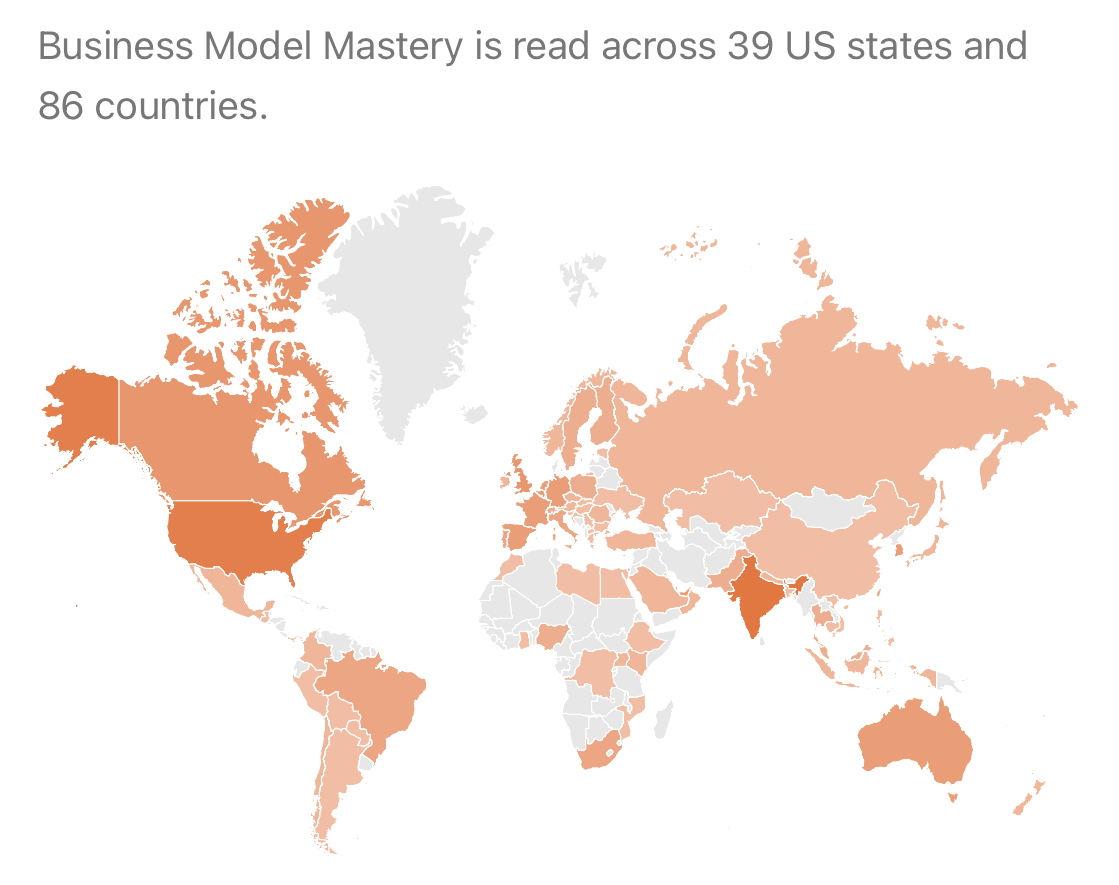
Trusted by 2,000+ private investors worldwide, Business Model Mastery is your daily ritual for building an edge over the market.
Each issue breaks down how great businesses truly operate—and what sets them apart by analyzing one company a day, helping you steadily build your own mental database of business models.
🧠 I handle the heavy lifting—digging into reports, filings, and key data—so you can focus on recognizing superior business models, comparing opportunities, and OUTTHINKING the market.
📖 With 110+ business models analyzed so far, you have a growing library of insights at your fingertips. Each analysis brings you closer to SHARPENING your edge and building the conviction to invest with clarity and confidence.
✅ If you haven’t yet, LOCK IN the lowest price before rates rise. The launch price has officially increased to $600/year — but for the next 10 spots only, you can still secure it for just $339 (40%+ permanent discount). This limited offer is valid until Sunday, April 27th, or until the final 10 spots are gone — whichever comes first.
➡️ The newsletter will remain daily—because consistent exposure is the fastest way to build a powerful mental database of business models. To make this habit easier to maintain, each issue will now begin with a sharp, clear Executive Summary, giving you the core insights in under a minute. You can go deeper when you have time—or stay on track even when you don’t. Like capital, knowledge compounds—small, daily insights lead to exponential returns. If you find this new format valuable, tap the ❤️ to let me know; your feedback directly shapes what stays.
Let’s begin.
EXECUTIVE SUMMARY
1️⃣ Scale & Logistics: Grainger manages over 1.4 million SKUs through a highly automated distribution network across North America, enabling same-day or next-day delivery for most products and generating 82% of sales from the U.S.
2️⃣ Dual-Segment Model: Its High-Touch Solutions generated $12.9B in 2024 at 18.9% margins, while Endless Assortment (Zoro + MonotaRO) delivered $2.9B with 10.1% YoY growth, covering both enterprise and SMB clients.
3️⃣ Private Label Strength: Proprietary brands contributed ~20% of total sales, enhancing margins and customer stickiness through exclusivity (e.g., DAYTON®, CONDOR®, WESTWARD®).
4️⃣ Technology Lock-In: The KEEPSTOCK® platform integrates with customer ERP systems, automating reorders and embedding Grainger into procurement operations, creating high switching costs.
5️⃣ Brand Trust & Resilience: With a nearly 100-year history, Grainger leverages its reputation for reliability, diversified supplier base (5,000+ partners, none >5%), and omnichannel service to defend against Amazon and industrial rivals.
Now, let’s step into the full article—where every detail comes together to reveal the complete picture. 👇🏻
I still remember the first time I stumbled upon the scale of W.W. Grainger’s distribution network. It wasn’t a simple warehouse or a scattered chain of small facilities. Instead, it was a deeply integrated logistics infrastructure that spanned North America and stretched into Japan and the United Kingdom. The numbers were almost intimidating. Grainger held over 1.4 million stocked SKUs in its vast distribution centers and branch networks, and the company partnered with more than 5,000 primary suppliers around the globe. This reach wasn’t just for show. It allowed Grainger to promise next-day delivery for a staggering percentage of its catalog, with same-day availability in many areas, especially for high-touch clients who needed critical parts immediately. I found it remarkable how this physical presence combined with automation to boost accuracy and speed. Smaller rivals and even huge eCommerce players found it challenging to match that level of reliability without sinking massive capital into infrastructure. Yet, Grainger had methodically built it all up over decades, creating a distribution moat that wasn’t easy to cross.
At the time, I wondered why Grainger seemed so committed to such a capital-intensive model. But then it hit me: in maintenance, repair, and operating (MRO) procurement, speed is currency. When a piece of factory equipment fails or a hospital’s systems need urgent maintenance, delays translate to losses or safety risks. Grainger’s ability to respond quickly, thanks to its strategic network of branches and automated distribution centers, turned that responsiveness into a powerful advantage. I’ve watched them refine this setup continually, embedding more automation, optimizing routes, and expanding SKUs. It’s no coincidence that 82% of Grainger’s consolidated net sales originated in the United States, the region where its infrastructure is most developed. That synergy between a massive footprint and high service levels is tough for any newcomer to duplicate.
Yet physical scale alone doesn’t explain why so many customers, from small shops to giant corporations, rely on Grainger. There’s another layer: the two-tiered business model that addresses both complex, high-touch procurement and more standardized online purchases. On one side, Grainger serves mid-sized to large enterprises through its High-Touch Solutions N.A. segment. In 2024, this segment generated $12.9 billion in revenue, with operating margins at 18.9%, significantly above the overall company average. On the other side, Grainger’s Endless Assortment platforms—Zoro in the U.S. and MonotaRO in Japan—focus on smaller businesses that prefer a self-service, digital-first experience. Those platforms collectively offered over 38 million products (split between Zoro’s 14 million and MonotaRO’s 24 million) and grew by +10.1% year over year, reaching $2.9 billion in revenue. The fact that over 40% of MonotaRO’s orders were fulfilled via third-party drop-shipping showed an impressive ability to scale inventory without tying up capital in slow-moving goods.
I love seeing how these two segments reinforce each other. Larger enterprises might require customized assistance, dedicated sales teams, or integrated on-site inventory solutions. Smaller outfits, meanwhile, often crave a streamlined online marketplace with easy searching and quick shipping. By operating both models, Grainger covers the entire market. Most rivals do one or the other—they either cater to complex B2B needs or run a user-friendly eCommerce site. Grainger’s split approach secures a broader slice of the MRO world. In my experience, this breadth makes the company resilient against market shifts. If the economy leans more toward centralized procurement with big contracts, the High-Touch side shines. If digital commerce takes an even stronger hold, the Endless Assortment side is ready to ramp up. It’s a classic case of hedging operational risk by mastering complementary channels.
Underneath all that, there’s yet another pillar people often overlook: private label products. This is where Grainger’s brand power really flourishes. Around 20% of its 2024 sales came from goods carrying its own trademarks, such as DAYTON®, WESTWARD®, or CONDOR®. I’ve seen these labels in machine shops and maintenance closets, and they’re not just cheap knockoffs; they’re reliable, well-regarded products that hold their own against established MRO brands. The margin upside is clear, since proprietary lines often yield better profitability than reselling third-party items. But there’s also a stickiness factor—when customers adopt a private label product, they often tie their processes to that line of consumables or replacement parts, making them less inclined to switch suppliers. Pricing power increases because Grainger isn’t just another distributor of common brands; it’s also the only source for its own trademarked items.
That emphasis on exclusivity appears again in Grainger’s KEEPSTOCK® program, an on-site inventory management solution that integrates directly with customer operations. I’ve seen KEEPSTOCK® in large factories where Grainger’s vending machines dispense everything from specialized fasteners to safety gloves, automatically updating stock levels in real time. Because it slots into procurement systems through Grainger’s eProcurement tools, clients have a smooth workflow that tracks consumption, reorders supplies, and organizes deliveries without the usual manual steps. The depth of integration is striking. I’ve heard procurement managers say they’d never consider switching away because that would require retooling their entire workflow. That level of operational lock-in is priceless in an industry where mistakes or downtime can be so costly.
And still, there’s more. Even with advanced distribution, dual market coverage, proprietary products, and integrated platforms, brand reputation remains a core driver of Grainger’s success. The company has operated since 1927 and has a century-long track record of reliable service. MRO purchasing is mission-critical; a single delayed shipment can halt a production line or compromise patient safety in a hospital. I’ve observed that longstanding trust in Grainger’s reliability isn’t just about nostalgic brand loyalty. It’s reinforced by consistent service, ethical practices, and an unwavering commitment to stocking the items customers need right when they need them. The brand’s signature “We Keep the World Working®” tagline resonates for a reason: MRO is all about minimizing downtime. Organizations gravitate toward partners they believe can deliver under pressure. That intangible capital—reputation—can’t be built overnight. It’s the product of decades of reliability and responsiveness.
When I step back and look at what prevents competitors from easily replicating Grainger’s success, I see multiple barriers. There’s the high infrastructure cost of matching Grainger’s massive branch network and distribution centers. Next, there’s the technological integration and trust needed to set up something like KEEPSTOCK®. Then you have brand equity, which emerges from nearly a century of proven performance. Finally, there’s a global supply chain that harnesses the power of over 5,000 suppliers, none exceeding 5% of total purchases. That level of diversification helps Grainger negotiate better terms, manage inventory risk, and prevent disruptions. It’s not just one “moat” but a series of layered defenses that fortify the company’s competitive position.
I find it especially interesting that this dominance has persisted despite competition from well-capitalized players. Amazon Business looms large in the eCommerce space, with a broad assortment and advanced logistics. But Amazon’s approach is primarily transactional, lacking Grainger’s specialized MRO expertise and deep B2B integration. Large industrial distributors like Fastenal or MSC Industrial can match parts of Grainger’s business model, particularly in high-touch service, but they struggle to replicate the scale and sophistication of Grainger’s online platforms. Grainger’s strategy to defend its turf revolves around continuous improvement—enhanced value-added services like KEEPSTOCK®, stronger private label offerings, and digital expansions like MonotaRO and Zoro. It’s a perpetual race, but Grainger’s head start is substantial.
One aspect I pay close attention to is the evolving technology landscape. The rise of AI-driven procurement could reshape how businesses source MRO products, with software handling a larger portion of decision-making. Autonomous logistics, including drone deliveries and robotic fulfillment, may eventually lower barriers to matching Grainger’s speed. However, Grainger appears proactive in adopting new technologies, from AI-based recommendation engines to advanced search algorithms. The resources it channels into R&D and last-mile logistics optimization suggest it won’t stand still while the industry transforms. If a competitor invests heavily in new technologies, Grainger can usually match or exceed that investment, leveraging its robust cash flow and established market presence.
Despite the possibility of new entrants or shifting technologies, Grainger’s core advantages look durable. The physical infrastructure, two-tiered segmentation, exclusive private labels, eProcurement integration, and nearly 100 years of brand equity converge into a cohesive machine that drives consistent growth. In my experience, such a multifaceted moat, especially in B2B distribution, doesn’t crumble easily. Even well-known competitors can find themselves outmaneuvered by Grainger’s combination of size, speed, and service depth.
I also pay attention to how Grainger fortifies these advantages over time. The company has a history of strategic acquisitions, such as expanding its ownership stake in MonotaRO in Japan. It continually raises the share of private label within its product mix, inching beyond 20% of sales with each passing year. Distribution center automation has been an ongoing priority, boosting throughput and decreasing shipping times. Meanwhile, the Endless Assortment platforms have grown more robust, widening the reach into smaller segments where digitization is accelerating. All these moves suggest a leadership team keenly aware of potential threats—and prepared to counter them before they gain momentum.
Of course, I’d be remiss not to mention that Grainger’s foothold in the MRO market isn’t immune to external pressures. Economic slowdowns can dampen purchasing budgets, forcing clients to postpone orders or look for cheaper alternatives. Changes in industrial production can shrink demand for replacement parts and tools. But that’s where the variety of customers—ranging from massive manufacturing plants to government entities—helps buffer the downside. If one sector tightens spending, others often maintain or increase it. Moreover, the broad geographical footprint allows Grainger to offset softness in one region with stability or growth in another. It’s a balancing act, but that’s why distribution scale and diversified customer segments matter so much. They spread risk and help the business maintain a consistent baseline, even when certain industries falter.
As I see it, anyone aiming to compete against Grainger has to overcome not just one or two obstacles but a tightly interlocked system of advantages. Distribution scale fuels speed and reliability. Private labels increase margins and loyalty. KEEPSTOCK® integrates into customer workflows and raises switching costs. The two-tier model captures a broad swath of demand, from high-touch corporate deals to self-service digital sales. The brand itself serves as a seal of trust. These elements reinforce each other to such an extent that replicating them all simultaneously is a colossal undertaking.
That synergy is precisely why Grainger’s leadership in MRO distribution has proven so enduring. It’s not dependent on a single product or a fleeting technology trend. It’s the outcome of decades of investment, close customer relationships, and strategic foresight. Even as new technologies emerge or consumer habits evolve, Grainger’s management has shown a willingness to adapt while keeping core values intact. The real secret, in my view, is that each piece—distribution network, dual market approach, proprietary lines, integrated solutions, brand trust—strengthens the others, creating a robust moat that’s hard to breach.
I often encourage fellow investors to look beyond short-term quarterly swings and focus on how these durable advantages compound over time. When a company’s supply chain can handle over 1.4 million SKUs, it tends to lock in more buyers, which eventually justifies further expansion of the network. When proprietary products capture a bigger share of sales, margins expand, and those profits can fund more R&D or acquisitions. It’s a virtuous cycle that leverages both physical infrastructure and digital innovation. The essence of Grainger’s success lies in that continuous cycle of reinvestment, refinement, and reinforcement.
I walk away from Grainger’s story convinced that few distribution businesses match its blend of scale, integration, brand power, and operational heft. The MRO space may not seem glamorous, but it’s the backbone of countless industries. If a retailer can’t secure the inventory to keep manufacturing lines running or hospital equipment functioning, it rapidly becomes irrelevant. Grainger, by contrast, has earned the trust of customers who rely on next-day delivery, immediate product availability, and thoughtful support services. Those relationships often become sticky and profitable for the long haul.
In the end, everything I’ve seen suggests Grainger’s position is anchored by a moat that goes beyond numbers on a balance sheet. There’s a culture of service, a deep knowledge of industrial procurement, and a willingness to invest in technology that sets it apart. Competitors come and go, but Grainger’s fundamentals—high-volume distribution, dual-segment coverage, exclusive products, seamless eProcurement, and near-legendary reliability—give it a staying power that’s rare in any industry. And as automation, AI, and new logistics solutions continue to emerge, Grainger appears poised to adopt and integrate them in ways that will only strengthen its competitive edge. That’s the insight I wish everyone understood: once a company embeds itself so deeply in critical industrial supply chains, it becomes exceedingly difficult to dislodge.
Let’s keep sharpening your edge, one business model at a time.
See you tomorrow.
✋🏼 P.S: Before you go, I have a few important messages to share with you. 👇🏻
Getting value from Business Model Mastery? Hit LIKE (❤️)—it’s how you shape what comes next.
Every issue breaks down how great businesses really work—exposing hidden revenue streams, competitive advantages, and the factors that keep them ahead. I do the deep research so you can spot opportunities before the market catches on.
But here’s the deal: Liking this isn’t just appreciation—it’s a signal. It tells me what’s resonating, what to double down on, and which insights sharpen your edge the most.
If this helped you see smarter, think sharper, and invest better, hit LIKE now—so I know to bring you more of it.
💡 Must-Reads You’ll Love
In Case You Missed Them: Our Most-Loved Must-Reads to Sharpen Your Edge 👇🏻
⏰ Your Limited-Time Offer
Right now, you can lock in a forever rate of $339/year—a permanent 40%+ discount from the regular $600/year. With only 10 spots originally available, just a few remain. Once they’re gone, the price rises—regardless of the deadline on Sunday, April 27th at 11:59 PM (California time). This isn’t just about saving money—it’s about securing a lasting edge. For less than a coffee a day, you’ll gain daily insights that break down how great businesses truly operate, analyzing one company at a time to help you steadily build a mental database of business models. I handle the heavy lifting—digging into reports, filings, and key data—so you can focus on recognizing superior business models, comparing opportunities, and outthinking the market.
And…
Payments are processed securely through Stripe, and your card won’t be charged until the subscription reaches $600/year—letting you lock in today’s discounted rate risk-free. While all past content is still free, it will soon become exclusive to paying subscribers. Subscribing now secures uninterrupted access at the current rate forever. This isn’t just a financial decision—it’s an investment in sharpening your thinking, understanding what sets winning businesses apart, and building a competitive edge that keeps you ahead of the market. Lock in your forever price today and start mastering business models to outthink—and outperform—other investors.
🚫 Check Your Spam Folder
Sometimes, emails with images or links end up in Spam or Promotions folders. If you don’t see the latest breakdown, please check there. Mark it as important, so you never miss a valuable insight. A single overlooked email could be the one that saves you from a big mistake or reveals an unexpected winner.
Disclaimer: This content is informational, not financial or professional advice. Investing involves potential loss, and by using this material, you agree to accept all risks and waive class-action rights. Full disclaimer is available on the About page.