
Inside Hemnet Monopoly
A Business Model That Redefines Real Estate in Sweden

In a world dominated by global tech giants, it’s rare to see a smaller, geography-specific platform achieve a near-monopoly. Yet Hemnet, Sweden’s leading real estate platform, has done just that, building a fortress-like business model powered by network effects, strategic monetization, and scalable technology. Let’s dive into why this company is not just a market leader in Sweden but also a case study in how to create a near-impenetrable business moat.
1. Network Effects: The Flywheel That Drives Hemnet’s Dominance
Imagine this: over 90% of all sold properties in Sweden are listed on Hemnet. With a staggering 42 million visits per month in 2023, the platform isn’t just popular—it’s indispensable. Buyers flock to Hemnet because it has the most listings, while sellers list there because that’s where the buyers are.
How strong is Hemnet’s grip on the market?
Listings on Hemnet receive 19 times more views than those on Sweden’s second-largest property platform. By visits per capita, Hemnet is the most popular real-estate platform on the planet. Its closest competitor in Sweden is 15–20 times smaller in traffic. This self-reinforcing cycle, known as a network effect, creates a moat that is almost impossible to breach.
For sellers, not listing on Hemnet means sacrificing visibility to millions of potential buyers, while buyers sticking to smaller platforms face limited options. This dual-sided dependency has locked buyers and sellers into the Hemnet ecosystem, making switching to competitors highly unlikely.
2. Monetization: The Global Gap Hemnet Is Closing
While Hemnet’s reach is unmatched in Sweden, it is still under-monetized compared to global peers. Hemnet’s average revenue per listing (ARPL) is around €400. Contrast that with Australia’s REA Group, which earns €1,500–€2,000 per listing, and it becomes clear that Hemnet is leaving money on the table.
But Hemnet is closing this gap rapidly. Over the past year, it grew ARPL by 37%, even while total listings fell by 12%. Sellers tolerate higher fees because they represent just 0.1% of the property’s value, a tiny fraction of the overall transaction cost.
Why does this matter? Hemnet’s pricing model is so elastic that it can increase fees or add premium features with minimal pushback. As Hemnet approaches monetization levels seen in markets like Australia, its revenue potential looks enormous.
3. Scalability Meets Profitability: Hemnet’s High-Margin Machine
Operating a digital platform at scale requires minimal additional costs. For Hemnet, this translates into stunning profitability:
• Adjusted EBITDA margins: ~52%
• Incremental EBITDA margins: Over 70%
• Net debt/EBITDA: 0.5x, offering financial flexibility.
What’s remarkable is how Hemnet sustains these margins while investing in innovation. Most of its traffic is organic, meaning it doesn’t need to burn cash on paid marketing to attract users. The business also reinvests smartly, allocating funds to share buybacks (450M SEK in 2023) and distributing 33% of net income as dividends.
Unlike traditional businesses, where scaling often leads to bloated costs, Hemnet’s digital nature ensures that as it grows, profitability improves. And with additional revenue streams, such as data analytics or premium advertising, the platform has untapped potential for even higher margins.
4. A Brand Trusted by Agents and Sellers Alike
Hemnet isn’t just a listing site; it’s an essential partner for Swedish real estate agents. Over 94% of agents use Hemnet, relying on its analytics tools, marketing features, and visibility to close deals.
Interestingly, Hemnet has reduced the commission rate paid to agents from over 30% to around 16–17%. Yet agents remain loyal because the platform delivers something irreplaceable: unparalleled audience reach. Sellers often demand their property be listed on Hemnet, creating a default expectation that benefits agents as well.
The result? A virtuous cycle where agents, sellers, and buyers are all invested in Hemnet’s ecosystem. Breaking this cycle would require an alternative platform not only to match Hemnet’s traffic but also to build trust over years—a near-impossible feat.
5. The “Seller-Pays” Model: A Profitability Engine
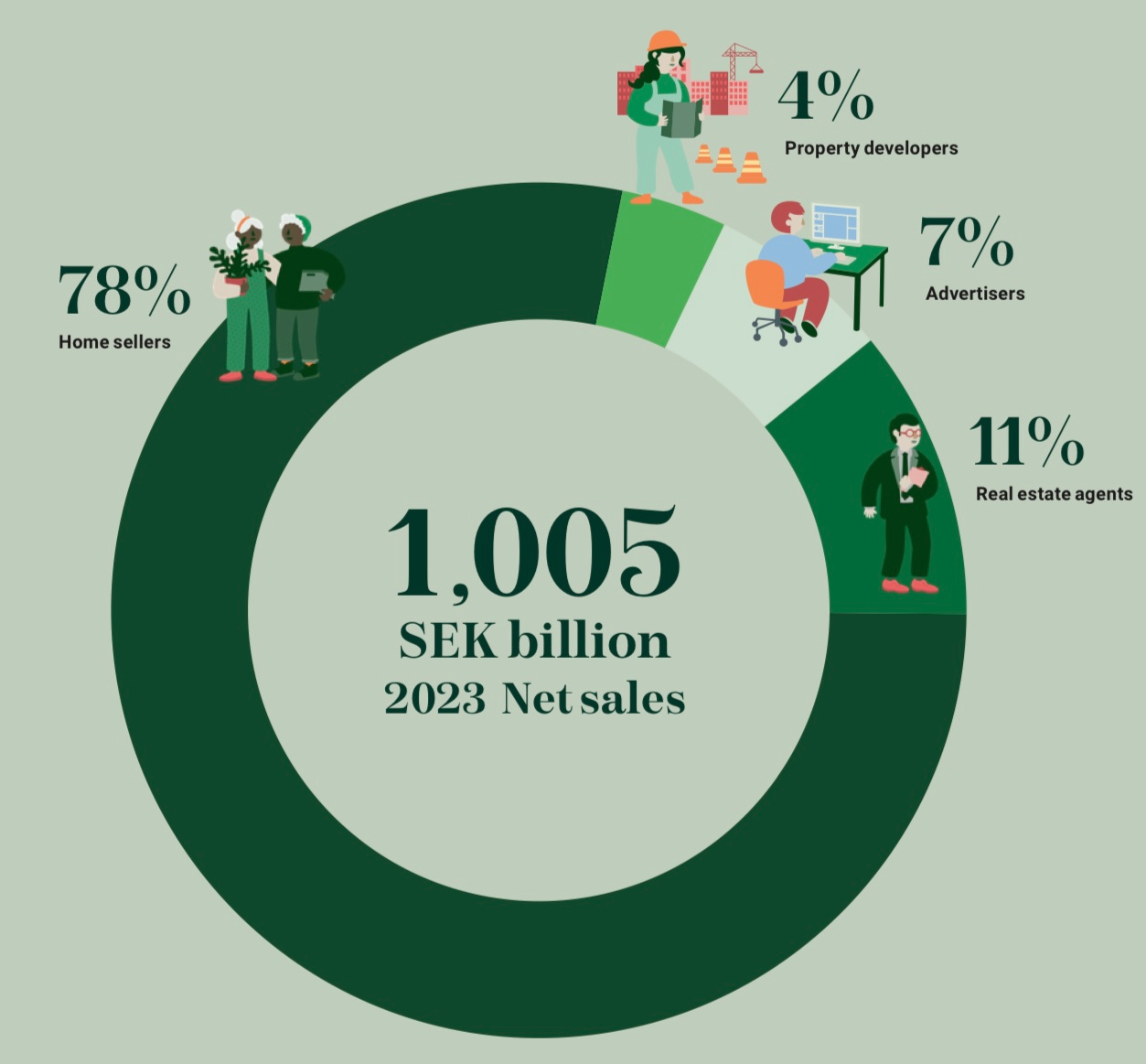
Unlike many global peers where agents pay for listings, Hemnet’s model shifts this cost directly to sellers. Listing fees represent just 4% of the total transaction costs, making them an insignificant expense compared to the property’s value.
Here’s where it gets interesting: Hemnet has successfully upsold premium listing options, like “Plus” and “Premium,” which now account for 60% of new listings. With potential to grow this figure to 80%, Hemnet can drive revenue higher without significantly raising base fees.
This model also gives Hemnet immense pricing power. Sellers are unlikely to resist modest price increases because the fees are such a small part of their overall transaction costs.
6. Leveraging Data and Diversifying Revenue
Hemnet isn’t just a listing platform; it’s a data powerhouse. By analyzing millions of property transactions and user interactions, it provides valuable insights to agents, advertisers, and developers.
• Advertising revenue: Accounts for 24% of Hemnet’s income.
• Targeted analytics: Allows advertisers to reach highly specific audiences, improving ad performance.
In the future, Hemnet can expand its data-driven services, offering tools like neighborhood analytics, property value forecasts, and market trend reports. These services not only diversify revenue but also deepen user loyalty.
7. Controlled Risk in a Cyclical Market
While real estate markets are naturally cyclical, Hemnet’s reliance on life events—like marriage, divorce, and job relocations—provides some resilience during downturns. Additionally, Sweden’s housing market has historically shown stability, offering a solid foundation for Hemnet’s growth.
That said, Hemnet’s single-market focus could become a vulnerability if Sweden’s real estate market experiences prolonged stagnation. However, its deep integration into the market and consistent demand from life events make it relatively insulated from short-term shocks.
8. A Moat Too Deep to Cross
Hemnet’s competitive moat is built on five pillars:
1. Network Effects: Dominant reach locks in both buyers and sellers.
2. Pricing Power: A seller-pays model with room for fee increases.
3. Profitability: Scalable operations with exceptional margins.
4. Data Depth: Insights that competitors can’t replicate.
5. Brand Strength: Agents and consumers trust and rely on Hemnet.
Together, these elements create a fortress-like business that is nearly impossible for competitors to disrupt.
9. Final Thoughts: Sweden’s Silent Giant
Hemnet is a testament to how a single-market focus, when executed with precision, can create a world-class business. With its near-monopoly, under-monetized potential, and scalable digital platform, Hemnet isn’t just a Swedish success story—it’s a masterclass in building and sustaining a market-leading business.
For investors, businesses, or anyone curious about what makes a company truly defensible, Hemnet’s journey offers invaluable lessons. And for those in Sweden, it’s hard to imagine buying or selling a home without Hemnet—a company that has made itself indispensable in the fabric of Swedish real estate.
P.S.: If you learned something new today about how businesses like Hemnet operate and thrive, consider helping this knowledge spread by simply liking or reposting this piece. A simple like shows me that you appreciate this kind of content, and it encourages me to produce more articles packed with insights like these. By engaging with this post, you actively shape the content you’ll receive in the future—your feedback truly matters.
I do the heavy lifting for you: digging deep into business models, breaking down complex strategies, and curating the most useful data to empower you with a clear understanding of how businesses really work. All you need to do is read, absorb, and build your mental database of cutting-edge business insights. With each piece, you’ll walk away smarter, more informed, and better equipped to make decisions that matter.
Now, here’s something important: this daily newsletter isn’t just a source of knowledge—it’s an investment in your future. Those who block the current price secure a permanent discount before the final price reaches $500/year. The current price is $237/year, valid only until Sunday, February 2, 11:59 PM (California time), or until the remaining few spots at this price are taken.
When these spots are gone, they’re gone—prices rise not only by date but also as subscriptions are claimed. So if you’re serious about learning how businesses like Hemnet build their success stories, now is the time to lock in your place. Early supporters are rewarded with the lowest rates and will never have to pay the increased future price.
At the moment, fewer than 10 spots are left at $237/year. Once they’re gone, the price increases further. This is your opportunity to save 50%+ off the final price and secure lifetime access to premium business insights for less than the cost of a coffee a day.
And here’s a thought: What better investment can you make than in yourself? Knowledge compounds over time, yielding exponential returns. While others are stuck making costly mistakes, you’ll have the advantage of understanding the intricacies of business success, day by day, insight by insight.
Your payment will only be charged once the final price of $500/year is reached, but by securing your spot now, you lock in this discounted rate forever. Payments are processed securely by Stripe, trusted worldwide to manage billions of dollars in transactions, so your information is safe.
Don’t wait. Secure your spot now before the last few are claimed. Take this step for yourself, your future, and the wealth of knowledge that will set you apart in understanding the world of business. The clock is ticking—why not lock in this advantage today?
50x forward pe. Too expensive?
You write that commission has come down to 16-17%, but I struggle to see how it's come down this far.
I get 29.69% comp rate to listing revenue for the rolling 12 months (listing revs 1 286.4mln vs comp at 382mln), and 29.74% on the last quarter (listing revs at 278.1mln vs comp at 82.7mln) - how do you calculate the compensation rate?