
Inside LVMH
The Blueprint Behind the World’s Leading Luxury Empire

How does a company become synonymous with luxury while dominating a global market worth over $330 billion annually? For LVMH Moët Hennessy Louis Vuitton, the answer lies in a combination of relentless diversification, innovation, and control over every element of the customer experience. The group’s 2023 financial performance, with €15.1 billion in net profit and €79.2 billion in revenue, shows just how well this formula works. But let’s break down how LVMH maintains its position as the world’s largest luxury conglomerate with over 75 brands (or Maisons) under its roof.
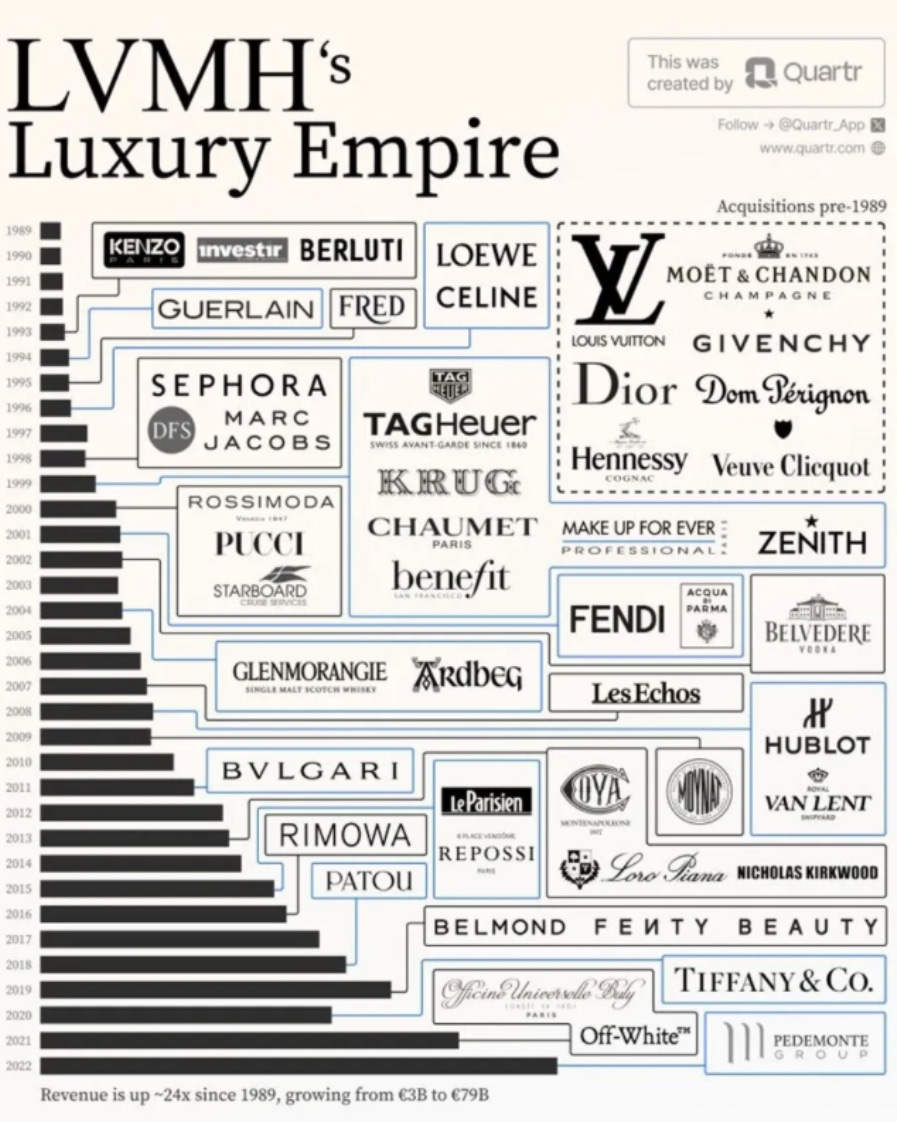
Unmatched Portfolio Diversity: Over 75 Brands, Five Divisions
LVMH’s 75 Maisons span five key sectors: fashion and leather goods, selective retailing, perfumes and cosmetics, wines and spirits, and watches and jewelry. This diversification gives it unmatched flexibility, allowing the company to thrive regardless of economic or regional slowdowns.
Key Metrics from 2023–2024:
• Fashion and Leather Goods: The backbone of LVMH, this division contributed €29.9 billion to revenue in the first nine months of 2024, or nearly 50% of total group revenue. Iconic brands like Louis Vuitton and Dior drive this performance, with Louis Vuitton alone generating over €20 billion annually.
• Selective Retailing: Sephora reigns supreme in this division, helping generate €12.6 billion in revenue with 6% organic growth, bolstered by expansions in the Middle East and North America.
• Wines and Spirits: While revenue dipped to €4.2 billion (-8% organic growth), marquee brands like Hennessy and Dom Pérignon ensured continued dominance in their respective categories.
• Perfumes and Cosmetics: This segment grew organically by 5%, earning €6.1 billion. The star performer? Dior’s Sauvage, the world’s best-selling fragrance.
• Watches and Jewelry: Tiffany & Co. headlines this division, which generated €7.5 billion, despite a slight decline (-3% organic growth). Over 25% of Tiffany’s stores have been revamped, fueling double-digit sales growth in flagship locations.
LVMH’s scale is a strategic moat. Where competitors like Kering depend heavily on single brands like Gucci (accounting for over 60% of its revenue), LVMH’s diverse portfolio spreads risk while ensuring resilience during regional or category-specific downturns.
Physical Retail: The Billion-Euro Gamble That’s Paying Off
In an increasingly digital-first world, LVMH bucks the trend by doubling down on physical retail investments. Why? Because luxury is experiential. The 5,600 LVMH-owned stores worldwide are more than sales channels—they’re brand sanctuaries that immerse customers in exclusivity and storytelling.
Strategic Investments:
• €7.5 billion invested in operations in 2023, including €2.5 billion allocated to flagship store renovations and real estate acquisitions.
• Tiffany & Co.’s Fifth Avenue flagship: The newly renovated store drove double-digit sales growth within months of its reopening in 2023.
• Louis Vuitton and the Paris 2024 Olympics: A sponsorship deal tied to exclusive flagship collaborations further strengthened brand visibility on the global stage.
Sephora, meanwhile, continues to grow its retail footprint with flagship openings in Oman and updated U.S. stores. This expansion reinforces Sephora’s status as the number-one beauty retailer worldwide, with increasing market share in the Middle East and North America.
What’s the ROI on these investments? Renovated stores consistently report double-digit sales growth, proving that the tactile, emotional element of luxury retail cannot be replicated online.
Commanding Pricing Power: The Science of Scarcity
Luxury isn’t just about quality; it’s about exclusivity—and LVMH has turned exclusivity into a science. A six-month waiting list for the Louis Vuitton Capucines Soft Bag isn’t an accident; it’s a strategy. By controlling supply and resisting the urge to cater to mass-market aspirations, LVMH preserves its brands’ allure while commanding top-dollar prices.
Key Metrics:
• Louis Vuitton Capucines Soft Bag: Launched in 2024, with demand so high that waitlists stretched for months.
• Dior Sauvage: The best-selling luxury fragrance globally, maintaining its position through targeted advertising and a steadfast premium pricing approach.
• Average price increase across brands: 5–7% annually, with no significant impact on demand—a testament to the group’s pricing elasticity.
This strategy isn’t just about aesthetics; it’s about profitability. LVMH reported a 26.5% operating margin in 2023, one of the highest in the industry. Competitors like Richemont (home to Cartier) trail significantly, hindered by reliance on discount-driven sales strategies.
Localization: The Secret to Global Relevance
What do Mumbai, Mexico City, and Seoul have in common? They’re all part of LVMH’s strategy to win over local audiences. Asia accounts for 33% of LVMH’s total revenue, but 40–45% of Chinese consumer spending now occurs in Japan, South Korea, and other travel hubs. By adapting to regional shifts in consumer behavior, LVMH maintains its grip on the world’s largest luxury market.
Localized Strategies:
• Dior’s regional fashion shows in Mumbai and Mexico City didn’t just showcase collections; they built emotional connections with key growth markets.
• Asia-exclusive collections: By tailoring products to cultural tastes, LVMH captures a larger share of local wallets while maintaining its global prestige.
• Sephora’s first store in Oman represents LVMH’s commitment to untapped markets, allowing it to diversify revenue streams beyond established regions.
Innovation: Bridging Timelessness with Trends
One of LVMH’s greatest strengths is its ability to balance timeless craftsmanship with modern innovation. For instance, 60% of Tiffany & Co.’s jewelry sales come from classics like the Tiffany T and Elsa Peretti collections, but modern launches like the Tiffany Knot appeal to younger demographics.
Key Product Launches and Events:
• Louis Vuitton’s Neverfull “Inside Out” bag: A 2024 reinterpretation of the classic design, which became an instant hit.
• Pharrell Williams’ debut menswear collection: Garnered over 1 billion online views, blending cultural relevance with product innovation.
• Dior Sauvage Le Parfum: A strategic extension of its already best-selling fragrance line, boosting sales in the perfume segment by 5% organically.
Innovation also extends to marketing. LVMH capitalizes on pop culture moments, using celebrity endorsements, music collaborations, and immersive social media campaigns to remain culturally relevant.
Why LVMH is Unbeatable
So, what makes LVMH unassailable in the luxury market? It’s not just the scale or the storied brands—it’s the group’s ability to weave together diversification, exclusivity, and innovation into a cohesive strategy.
Competitors like Kering (with its reliance on Gucci for over 60% of revenue) or Richemont (heavily reliant on Cartier and jewelry sales) lack LVMH’s breadth and adaptability. LVMH’s strategy of reinvesting profits—whether in flagship stores, brand acquisitions, or cultural collaborations—ensures it’s constantly evolving while staying true to its roots.
Ultimately, LVMH doesn’t just sell luxury; it defines what luxury means for generations. The next time you walk past a Louis Vuitton window or spot Dior on a billboard, you’re witnessing not just a brand but a meticulously crafted empire at work.
P.S.: If you’ve made it this far, I know you’re serious about understanding how businesses like LVMH operate—and that’s why I want to continue delivering insights like these to you. Hit like on this article if you enjoyed it because your engagement directly influences the kind of content I produce for you in the future.
Here’s the deal: I do the hard work of finding, analyzing, and digesting the information so you don’t have to. Every day, I bring you valuable insights that help you build a mental database of business models and strategies. All you need to do is read, absorb, and grow. Imagine how much you’ll know after 365 days of this kind of advanced knowledge. You’ll start to see how businesses really work—making you smarter, faster, and more informed than the average investor.
But let me share something important about this newsletter’s pricing policy. The earlier you lock in your subscription price, the less you’ll pay compared to those who join later. I want to reward those who trust me first and recognize the value of these insights. Today, the annual subscription is available at a limited-time price of $237 until Sunday, February 2, at 11:59 PM California time. Here’s the catch: there are only a few spots left at this price, and they’re going fast. Once these spots are taken, the price goes up—even if the time deadline hasn’t been reached.
And this is a big discount. The final price will be $500 per year—so locking in today means over 50% savings. This is a one-time opportunity to secure a permanent price for your subscription. No matter how much the price increases for future subscribers, your price will never change.
Think about it—less than the cost of a coffee a day can give you priceless knowledge that compounds over time, making you a sharper, more strategic investor. Knowledge is the one thing that nobody can take away from you, and it’s the best investment you can make in yourself.
Oh, and your payment data? It’s 100% safe. Your card will only be charged once the price reaches $500/year, and Stripe—a trusted platform managing billions of dollars in payments—handles all transactions securely.
Don’t wait. The remaining spots at $237 won’t last long, and once they’re gone, they’re gone for good. If you’re serious about building your financial knowledge, seize this opportunity now. The earlier you join, the more you’ll save—and everyone who comes after you will pay more.
Secure your spot today. Your future self will thank you for it.
P.P.S: You may also like…